
Booking + AI
A birthday party, scribbled on the back of a box — booked from a photo.
The note came in the way half of them do: a booker's handwriting on whatever paper was nearest. A name, a kid's name, a date, a phone number, and a couple of figures — one of them crossed out. Normally that's a few minutes of squinting and data entry before it becomes a booking. This time we photographed it, sent the photo to the assistant, and typed four words: “book this birthday party.”
What follows is a real exchange from our own account. We've swapped the names and contact details for a made-up family — everything else is exactly how it happened.
What actually came in
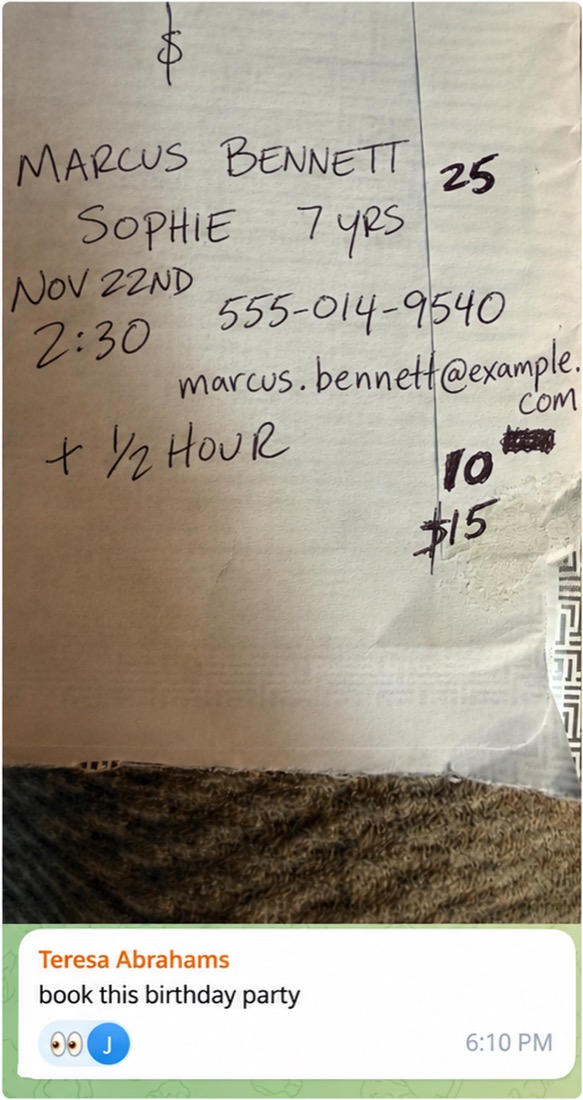
It read the note back — then it stopped
First it pulled out the parts it was sure of:
Then it did the thing that actually matters — it didn't guess:
1. In-house or away? No street address is written down, which usually means In-House ($400). If it's at their place I'd need the address before it's bookable.
2. The scratch numbers — there's a “25,” a “10” crossed out, and a “$15.” I can't tell if those are headcount, add-on pricing, or a deposit note. The “+ ½ hour” is clearly an extra-time add-on. If any of those are the price, they'll change the total.
On a real client, a confident wrong guess is worse than a question. So it asked.
One sentence of context, and it was done
Sophie Bennett, 7th Birthday · Birthday In-House · Sun 2026-11-22, 2:30–5:00 PM · 25 participants.
Price $725 — $400 base covers 10 kids, 15 extra × $15 = $225, plus $100 for the half hour.
Contract template applied · 20% deposit = $145.
Look at the price for a second. It didn't just take “$100 for the half hour” and stop — it rebuilt the whole total from our package rules: the base covers ten kids, twenty-five are coming, so fifteen extra heads at $15 is $225, plus the $100 add-on. $725. The mystery numbers on the box flap finally made sense — and they were in the booking, priced correctly, without anyone doing the arithmetic by hand.
“Send Marcus the contract.”
That's the whole booking — from a photo of a torn box flap to a signed-contract link in the booker's inbox. And here's the part worth noticing: the assistant's actual work — reading the note, pricing it against our packages, writing the booking, sending the contract — happened in seconds each time. The only real time that passed was the gaps while I got back to it with the two answers it needed. The computer was never the slow part. I was — and that's exactly how it should be.
You're still the one deciding
Worth being clear about what happened here, because it's the whole point. The assistant read the note, priced it against your real packages, and asked before it guessed. It booked nothing until the two open questions were answered, and it sent nothing until we said “send.” Reading and drafting are instant and safe; committing a booking and emailing a client are deliberate, and they're yours. It's a very fast assistant — not an autopilot.
The data entry you've done ten thousand times is the part a computer should have taken off your hands years ago. The judgment — in-house or away, is that a price or a headcount — is the part that's still yours. That's the split, and it's the right one.
More like this, occasionally.
The Working Act — short notes on getting and running gigs, from 40 years of booking our own. No spam, unsubscribe anytime.